

Cryptographic Attestation Explained for B2B Marketers
Machine-checkable proof helps B2B vendors win trust with AI buyers before humans get involved.
October 31, 2026
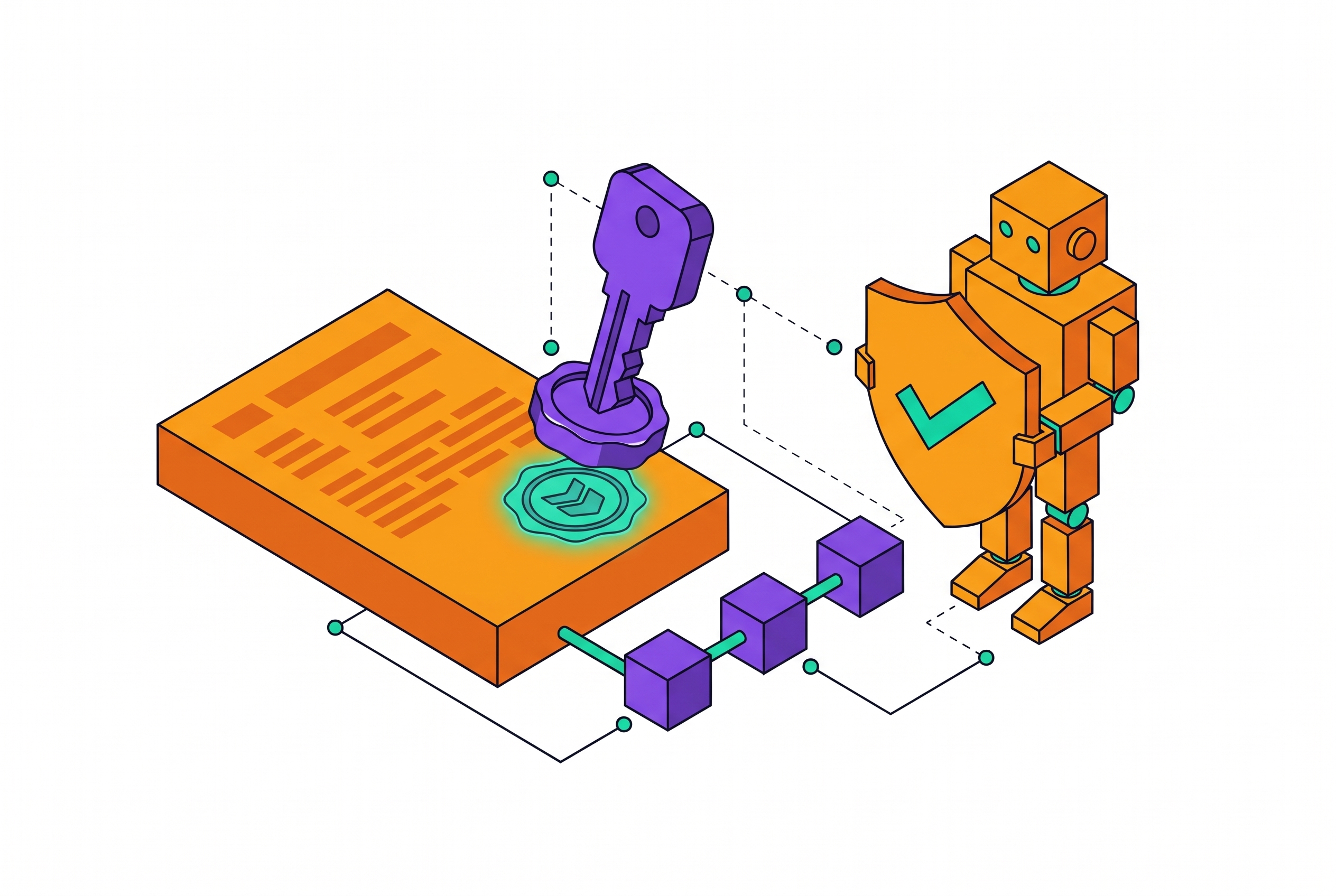
Cryptographic attestation gives B2B marketers a way to make specific vendor claims independently checkable by machines. As AI agents take on more buying tasks, credible proof must do more than persuade a reader. It must let an evaluator check who issued a claim, what evidence backs it up, and whether the signed record is still valid.
How AI agents have taken over the top of the B2B software buying funnel
IDC’s August 2026 CMO Buyer Alignment Blueprint says that a large majority of B2B technology buyers use AI agents to help with buying tasks or do those tasks for them. Its account of discovery describes agents surfacing and prioritizing solutions before human evaluation begins. Vendors thus face an evaluator before they get to talk about a sale. That evaluator can shape which products a buyer considers without first encountering the vendor’s carefully ordered sales narrative.
This does not mean procurement has become uniformly autonomous. Agent-assisted buying and fully agent-run evaluation are different levels of adoption, and the distinction limits what vendors can assume about any individual purchase. Even so, buyers increasingly find products through a machine intermediary. When that intermediary filters the options, awareness and consideration can collapse into the same operation. The vendor’s information architecture must make its offering both findable and trusted.
What AI agents actually do when they evaluate a software vendor
A buyer can begin with a natural-language instruction rather than a search query followed by a series of website visits. An agent can scan indexed repositories, rule out options that do not fit, and compare the rest without taking the buyer through search engine results pages. The sequence changes what content must accomplish. The vendor must make facts available for the agent to find and compare, rather than rely on holding its attention long enough to tell a story.
In agentic evaluation, retrieval is only the beginning. The agent can parse structured data, query APIs, and cross-check a candidate’s claims before acting. Relevant inputs include crawlability, API and developer accessibility, pricing clarity, structured data, and ecosystem maturity. These inputs make a product intelligible to software. A persuasive page cannot substitute for an accessible answer about a capability or its price.
A claim that appears in a vendor’s documentation, pricing page, and customer evidence is easier to check when those sources agree. Conflicting accounts leave the evaluator with an unresolved question about which version to use. This is a different task from finding a relevant passage and quoting it. An agent evaluating evidence may discount an unverifiable claim.
Why traditional social proof — case studies, testimonials, logo walls — fails the machine-verification test
Traditional social proof was designed for a different reader. Visual hierarchy, benefit-focused copy, and gated case studies assume someone who interprets context and extends a degree of good faith. Those assets can still help a human understand a product’s value. They can also supply useful signals to an agent. They can persuade, but they lack evidence that someone can check on their own to see whether the claim holds up.
A PDF case study may name a customer and report a headline outcome without linking either to a verifiable data source. An agent can extract the assertion, but extraction does not establish that the outcome occurred. Logo walls leave even more unstated. A company name alone does not establish which features it uses, when it used them, or whether the relationship remains active. Vendor-published testimonials likewise require scrutiny of their attribution and supporting evidence.
Third-party evidence improves attribution but does not settle every question. G2 reviews and analyst reports have value as signals because they offer views from outside the vendor’s own marketing. Yet they remain snapshots of an assessment at a particular time. Establishing what a specific customer actively uses today requires additional evidence, especially when a buyer needs to assess a named feature.
Missing evidence also creates work for the buyer. Someone must clear up the doubts by checking the evidence by hand or adding more oversight, even when the product itself is strong. The proof asset has then introduced friction rather than removed it. This is the gap between what a human buyer may accept on faith and what an agent needs to verify. Cryptographic attestation addresses that gap by changing the form of the evidence.
What cryptographic attestation actually is, in plain terms a marketer can use
Cryptographic attestation is a hardware-signed or cryptographically signed record of a specific claim at a specific time in a verified environment. For a marketer, the useful distinction is between an assertion on a page and a record whose issuer and integrity can be checked mathematically. The signature makes the record independently checkable. Its evidential value still depends on what the issuer actually observed or established.
The basic process has three roles. An issuing authority signs a credential, and the credential subject holds it. That subject may be the vendor or a customer acting on the vendor’s behalf. A relying party, such as an AI agent, checks the signature against the issuer’s public key and confirms that the credential has not been revoked. The agent can check the signature without calling the issuer or trusting the vendor’s marketing copy.
The scope of the claim is crucial. A signature on a vendor statement establishes the signed statement’s provenance. A claim-level attestation must therefore make clear which customer interaction, feature use, or outcome it covers and what evidence supports that claim. Otherwise, the mechanism may make an ordinary claim look technical without adding facts to back it up.
SOC 2 answers a different question from cryptographic attestation. It is a human-audited, periodic compliance assessment, rather than a machine-checkable record of a particular session, feature, or usage event. An agent seeking evidence of active product use cannot obtain it merely from a vendor’s SOC 2 status. A compliance assessment also offers broader assurance than a signed usage record can give. These forms of proof have different jobs.
The distinction also explains why encryption is not an adequate answer to a request for attestation. Encryption does not identify the specific customer event or outcome that a signed record is meant to substantiate. Generative AI makes this separation more urgent because plausible content can be produced at scale without establishing its provenance. For machine evaluation, the unit of proof becomes the attestation endpoint.
What feature-level and customer-level attestation look like in practice
Feature-level attestation connects a product capability to checkable evidence of use. The useful record names the customer and capability, ties the claim to usage evidence, and distinguishes observation from assertion. Specificity gives the evidence a defined purpose. An agent can fetch the endpoint, verify the signature, and use the supported feature-customer pairing in a comparison. A signed statement of general customer satisfaction cannot answer the same question.
Customer-level attestation applies that discipline to the relationship itself. A static “customer since 2021” badge asserts tenure without establishing current activity or depth of use. A signed, dynamically updated record can instead associate a specific customer with evidence of active product use. However, activity and feature adoption are not interchangeable. Observed sign-ins or sessions back up a claim of activity, while a feature-use claim needs evidence that the feature was used.
Letterprove illustrates both the infrastructure and the importance of that boundary. It installs through a single script tag, observes customer product usage through sign-ins and sessions, and publishes signed attestation endpoints that agents can fetch, verify, and cite. Its feature sets are vendor-stated and labelled as such in the signed attestation. That label is essential to interpreting the proof. A signed feature statement must not be presented as independently observed feature adoption when the observation concerns sessions.
Endpoint design also needs precise treatment. Letterprove’s codebase describes a move from per-customer endpoints to one signed attestation per vendor, while its homepage still displays a per-customer endpoint example. The difference leaves the endpoint structure unresolved in the supplied material, rather than supporting a promise of one endpoint per customer. More broadly, the endpoint, schema markup, and third-party citations need to agree about who uses what. Cryptographic integrity does not resolve contradictions between the records an agent encounters.
Why discovery alone is no longer enough and verified proof is what closes the shortlist
Discoverability earns consideration, while evidence supports selection from the shortlist. Structured data, JSON-LD schema, machine-readable pricing pages, and public API documentation help agents find and understand a vendor. These are established ways to improve accessibility. They do not independently establish that a customer achieved a claimed outcome or actively uses a capability.
Of two shortlisted vendors, one provides signed records with clear provenance and scope, while the other offers a logo wall and a PDF case study. The first gives an agent a checkable basis for assessing the supported claims. Which product is better is still an open question. It does reduce the evidential uncertainty that would otherwise fall to the buyer’s team to resolve.
AEO and discoverability investment are consequently incomplete without a proof layer. More exposure cannot repair evidence that fails at the point of evaluation. By contrast, dynamically updated attestations can add current usage evidence as customers continue to use the product. These attestations help only if they keep observed facts clearly separate from what the vendor says. When that distinction holds, the verifiable record can accumulate while a competitor’s static case study remains a snapshot.
What a B2B marketer should do next to prepare their proof stack for agent evaluation
The first step is to audit machine-readability. Can an agent access the pricing page, feature documentation, and customer evidence without encountering gates, file downloads, or benefit-only copy? This establishes the starting point for the work. Structured fact sheets using JSON-LD, including Organization, Service, and Review schema, provide a baseline that software can parse. Pricing pages should be references that agents can work from, while public API documentation and OpenAPI specs make it easier for agents to evaluate the product.
The second step is to replace static case studies as the primary machine-facing evidence with structured, schema-tagged outcome records. At minimum, name the customer, capability, and outcome in a form that an agent can read without opening a file. Structure alone is not verification, however. The record also needs a connection to a live data source or signed endpoint that supports its claim. This separates the work of organizing evidence from the work of substantiating it.
The third step is to implement attestation infrastructure. The qualifying test is whether the system can produce a signed record for the relevant customer interaction or feature claim that an agent can fetch and verify. SOC 2 status does not answer that question. Letterprove is an option for this layer because it observes product activity and publishes signed attestations, but its vendor-stated feature labels and endpoint design need to remain explicit in the proof strategy. The infrastructure must show what the evidence backs up and keep clear limits on what it claims was observed.
The fourth step is to reconcile every source an agent might cross-check. The attestation endpoint, schema markup, third-party review profile, and pricing page should agree wherever they describe the same customer, capability, or commercial fact. As the proof changes, the information around it must keep up and state the same facts that the evidence backs up. The final operational test is whether an evaluator can move from a claim to its evidence without having to resolve the vendor’s contradictions.