

How AI Agents Discover B2B Software Vendors
AI agents now filter vendor shortlists before humans ever see them.
September 28, 2026
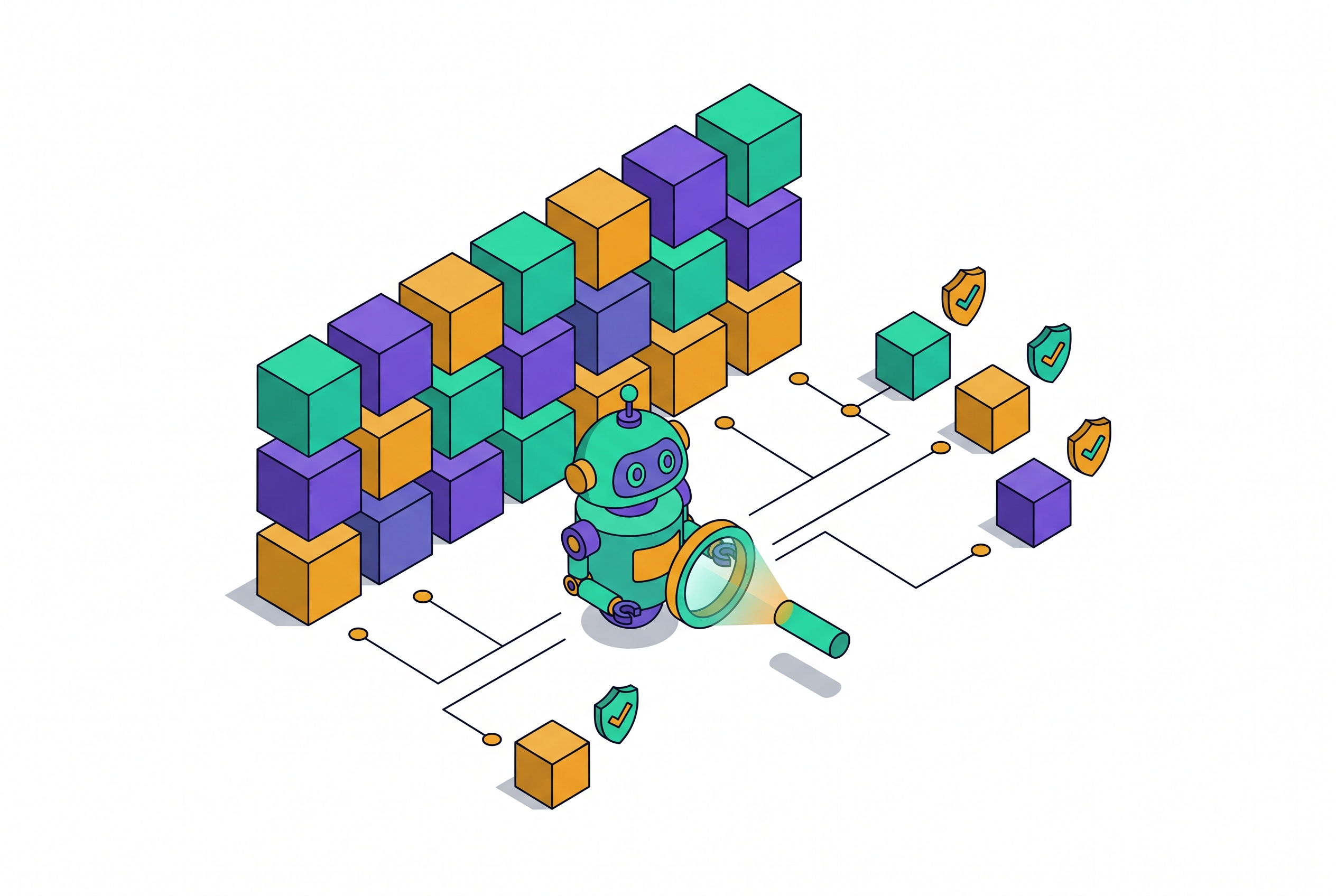
The way B2B buyers find software vendors has already changed, and the change is not subtle. That compression is the clearest sign of what's underway, and it's already measured, not projected.
Separate research from Forrester puts the number of B2B buyers using generative AI as a research source at 89%, and finds that 94% of business buyers used AI somewhere in their buying process during 2026. Gartner's own forecast pushes the timeline further out: by 2028, the firm expects 90% of B2B buying to run through AI agents, moving more than $15 trillion in B2B spend through agent-mediated exchanges.
The consequence for vendors is blunt. The average buyer shortlist dropped from 3.2 vendors to 2.5 in the space of a year, and 83% of buyers now shortlist three products or fewer. A vendor that doesn't make that shortlist doesn't get a second look, a follow-up call, or a chance to correct the record later. It just doesn't exist to that buyer. Fully 80% of B2B buyers now employ AI search in their purchasing process, and 51% begin vendor research specifically in AI tools, according to the G2 2026 Buyer Behavior Report.
What AI agents do during the vendor discovery and evaluation process
Google's Deep Research agent, in a single test run, reviewed 266 websites and produced a 14-page report citing 75 sources. No sales rep, analyst, or procurement team does that in one sitting. That's the baseline capability vendors are now up against, and it explains why the shift in section one isn't just about buyers preferring a new channel. It's about a fundamentally different research process replacing the old one.
The mechanics work like this: a buyer gives an agent a plain-language instruction, and the agent scans indexed repositories, throws out what doesn't fit, and returns a direct comparison, never touching a search results page along the way. That capability didn't appear all at once. It built up in three phases. First, buyers used AI tools simply to summarize vendor options, a faster version of reading. Then agents started scoring vendors against stated criteria and producing ranked shortlists on their own. Now, in the most advanced deployments, agents run the whole procurement cycle end to end: gathering requirements, shortlisting vendors, negotiating terms, reviewing contracts, and in some cases executing the purchase.
Buyers still keep final decisions in human hands. The top agent use cases today are evaluation tasks, not autonomous purchasing, things like comparing total cost of ownership or building a shortlist (51% of use cases fall here). Buyers delegate the grunt work, not the judgment call. But the grunt work is exactly where vendors get filtered out before a human ever sees the list, and that filtering runs on different logic than keyword search ever did. Agents don't chase keyword variations the way a search engine crawler might. They parse structured data, follow semantic markup, and weight a brand's standing by how often and how authoritatively independent publishers cite it.
Payment infrastructure is catching up to this shift too, if a step behind. Visa launched Intelligent Commerce in 2025, and Mastercard followed with its own Agent Toolkit. Visa's Trusted Agent Protocol exists specifically to tell legitimate AI agents apart from malicious bots, and by December 2025 Visa reported its partners had already completed hundreds of secure, agent-initiated transactions. Evaluation and transaction are becoming a single continuous machine process, and vendors need to be visible at every link in that chain. AI agents operate across three capability phases during the vendor discovery and evaluation process.
The signals that determine whether a vendor surfaces in an agent-generated shortlist
Some content earns a spot in an agent's shortlist, and some quietly disappears from consideration without the vendor ever knowing it happened. The pattern is consistent enough to describe. Product specs laid out in tables, pricing posted openly on pages an agent can index, direct feature comparisons against named competitors, case studies with real numbers and named customers, integration documentation, and pages marked up with schema.org tags for product, organization, pricing, and reviews: all of that gets read, weighed, and cited.
The opposite kind of content gets ignored. A claim like "increased revenue" carries no evaluative weight next to something like "increased marketing-sourced pipeline from $400K to $1.2M in Q3 2025. One is a phrase; the other is a data point an agent can compare against a competitor's data point. Specs locked behind a form fill or buried in an untagged PDF fare no better: an agent will either miss that information entirely or mark the vendor down for hiding it. Generic brochure copy that never gets specific just blends into the background noise an agent is built to filter out.
Third-party citation now works as a distinct, measurable ranking input. Analyst reports, trade press coverage, and verified review platforms feed directly into what agents recommend, the same way backlinks once fed search rankings. Review sites are now the single biggest influence on which vendors make a buyer's shortlist, at 38%, narrowly ahead of AI chatbots themselves at 37%, the first time review sites have topped that list. Analyst relations and review management are a direct input into AI discovery now. They're a direct input into it.
The structural penalty for thin data is unforgiving, and there's no way around it. An agent simply cannot rank a vendor it cannot read, so incomplete attribute fields, spec sheets that only exist as PDFs, and pricing hidden behind a login wall don't lower a vendor's score. They remove the vendor from consideration entirely, before any human buyer sees a shortlist at all.
How machine-readable discoverability standards are reshaping vendor infrastructure requirements
Most B2B vendors built their online presence for a human reader: a visual layout meant to guide the eye, copy written around benefits rather than specs, and technical detail tucked behind a form. None of that translates the way vendors assume it does, because agents don't parse a page the way a person scrolling on a laptop does.
A set of standards is forming to close that gap, though it's still early and pieces don't yet line up neatly. The Model Context Protocol, open-sourced in November 2024, has become the leading candidate for standardizing how agents discover vendor information, with major platforms adopting it through 2025 and into 2026. OpenAI and a payments partner introduced the Agentic Commerce Protocol in September 2025, giving agents a standard way to read product catalogs and carry buying context from one step to the next. Google followed in January 2026 with its own Universal Commerce Protocol, built for the same purpose. Alongside these sit smaller, less coordinated efforts, WebMCP manifests, mcp.json files, agent.json signals, evidence that this is still an early-stage environment rather than a settled one.
For vendors, that translates into real engineering work. Product catalogs need to be machine-readable with pricing that's actually authenticated. Account-specific pricing rules need to live somewhere documented and structured, rather than sitting in an ERP system or in one employee's head. And human approval still needs to sit on both sides of any agent-mediated transaction, a safeguard, not an afterthought.
This isn't a hypothetical future requirement. Gartner projects that by the end of 2026, 40% of enterprise applications will include task-specific AI agents, up from under 5% in 2025. The most common mistake vendors make right now is building only for the human visitor, while specs and pricing sit buried inside PDFs and unstructured documents that no agent can parse. Machine-readable discoverability standards are reshaping vendor infrastructure requirements through API-driven quoting and real-time ERP data exposure.
Agent experience design as the emerging discipline that organizes these requirements
A name has settled onto this work: Answer Engine Optimization, or AEO. It means structuring content so that platforms like ChatGPT, Perplexity, Google AI Overviews, and Claude cite a brand directly when answering a user's question. The goal isn't ranking a URL on a results page anymore. It's becoming the source the model actually pulls from when it writes its answer.
AEO isn't SEO with a new label slapped on it. It calls for citation architecture, entity optimization, structured data, and an off-page brand presence built specifically for how large language models retrieve and surface information. Measurement looks different too: tracking how often a brand gets cited across multiple LLMs is the actual deliverable now, and a report full of Google Search Console screenshots signals an SEO program still stuck in the old model, not an AEO one. Brand recognition built on traditional search performance is not evidence of AI search capability.
The commercial upside is already showing in the numbers. One survey of 400 senior marketing executives found AI-native platforms like ChatGPT and Perplexity now rank as the second-most-common source of qualified leads, behind social media and ahead of organic search, email, and paid channels. A practitioner market has grown up around that fact quickly. Named entrants in this space include DerivateX, Omniscient Digital, Embarque, First Page Sage, NoGood, and Minuttia; NoGood, founded in New York in 2016, launched a dedicated Answer Engine Optimization service line in May 2025, and a wave of established SEO agencies added their own GEO and AEO offerings through 2025 and into 2026. TrustRadius frames the same shift under the label Generative Engine Optimization, or GEO, arguing that AI recommendations are shaped heavily by third-party sources, user reviews and independent publications chief among them. A vendor's external footprint now needs active, ongoing management rather than occasional attention.
Why traditional social proof fails the agents that now control shortlist formation
More reviews get read. Fewer get believed on their own. That gap matters more for agents than for humans, because an agent isn't persuaded by tone or repetition. It needs something it can actually verify.
Logo walls make the point cleanly. Among B2B SaaS brands that ran an A/B test removing their customer logo bar, 88% saw conversions go up. Logos score just 18 out of 100 on standard conversion-likelihood benchmarks. A wall of logos tells an AI agent nothing usable: not which features those customers actually run, not what results they got, not whether the relationship is even still active. It's decoration, not data.
Static case study PDFs fare no better. They're unindexed, carry no schema markup, and can't be parsed the way an agent needs, which makes them functionally invisible during evaluation, regardless of how strong the story inside them might be. A line like "increased revenue" is not citation-ready, while "increased marketing-sourced pipeline from $400K to $1.2M in Q3 2025" is, because agents require specificity to include a claim in a comparison.
None of this lowers the bar for human-facing proof, either. It raises it. Forrester expects roughly one in five B2B sellers to face agent-led quote negotiations by the end of 2026, and vendors whose proof can't be read by a machine will lose those deals during evaluation stages they never even knew were running. The paradox of social proof in 2026 is that 97% of consumers read reviews before purchasing, yet trust in individual reviews collapsed from 79% to 42% by 2025, according to BrightLocal. 94% of buyers who used AI fact-check AI responses at least some of the time, according to the TrustRadius 2026 B2B Buying Disconnect Report, proof that any evidence satisfying an agent must simultaneously hold up to direct human scrutiny, since the bar is not lower for machine-readable proof but higher.
What machine-verifiable, dynamically current proof looks like
The standard now taking shape is cryptographic attestation: a signed statement that ties a cryptographic hash, provenance metadata, and contextual detail to a specific claim, immutably and transparently, so an agent can verify it without ever having to trust the vendor's own marketing copy. That's the structural shift. Proof is now a record a third party can check, rather than a story a vendor tells, because verifiable data ties source, metadata, and contextual detail to a specific claim, immutably and transparently, so an agent can verify it without ever having to trust the vendor's own marketing copy.
Formal standards work already backs this up. Around that core sits a broader family of specifications covering data integrity, the cryptographic suites that back it, JOSE and COSE credential security, and controlled identifiers, forming standards infrastructure already in active use. This is standards infrastructure already in active use. It's standards infrastructure already in active use.
Feature-level detail matters because an agent evaluating fit needs to know which specific customer uses which specific capability, not just that a logo exists somewhere on a customer page. And it needs that information current, not frozen in time. An attestation endpoint that updates continuously as customer usage evolves is a categorically different object from a case study PDF published once and never refreshed. Enterprise procurement teams already lean this direction on their own: most now ask for assurance artifacts early in the buying cycle, and deals stall out even when a vendor's sales team believes, on paper, that everything's in order.
Letterprove was built directly for this gap. It installs with a single script tag, observes how customers actually use the product, and publishes signed attestation endpoints that AI agents can fetch, verify, and cite when they build a vendor comparison. Every attestation ties to one specific customer, one specific feature set, and live usage data, independently checkable without asking the agent to take a vendor's word for anything. The W3C Verifiable Credentials Data Model v2.0, published May 15, 2025 and standing as the current W3C Recommendation, defines issuers, holders, verifiers, credential subjects, claims, validity, and status. VCDM v2.1 is a W3C Working Draft as of April 9, 2026.