

Machine-Readable Proof Endpoint Architecture
Vendors must publish machine-readable proof endpoints or lose to AI buyers.
October 3, 2026
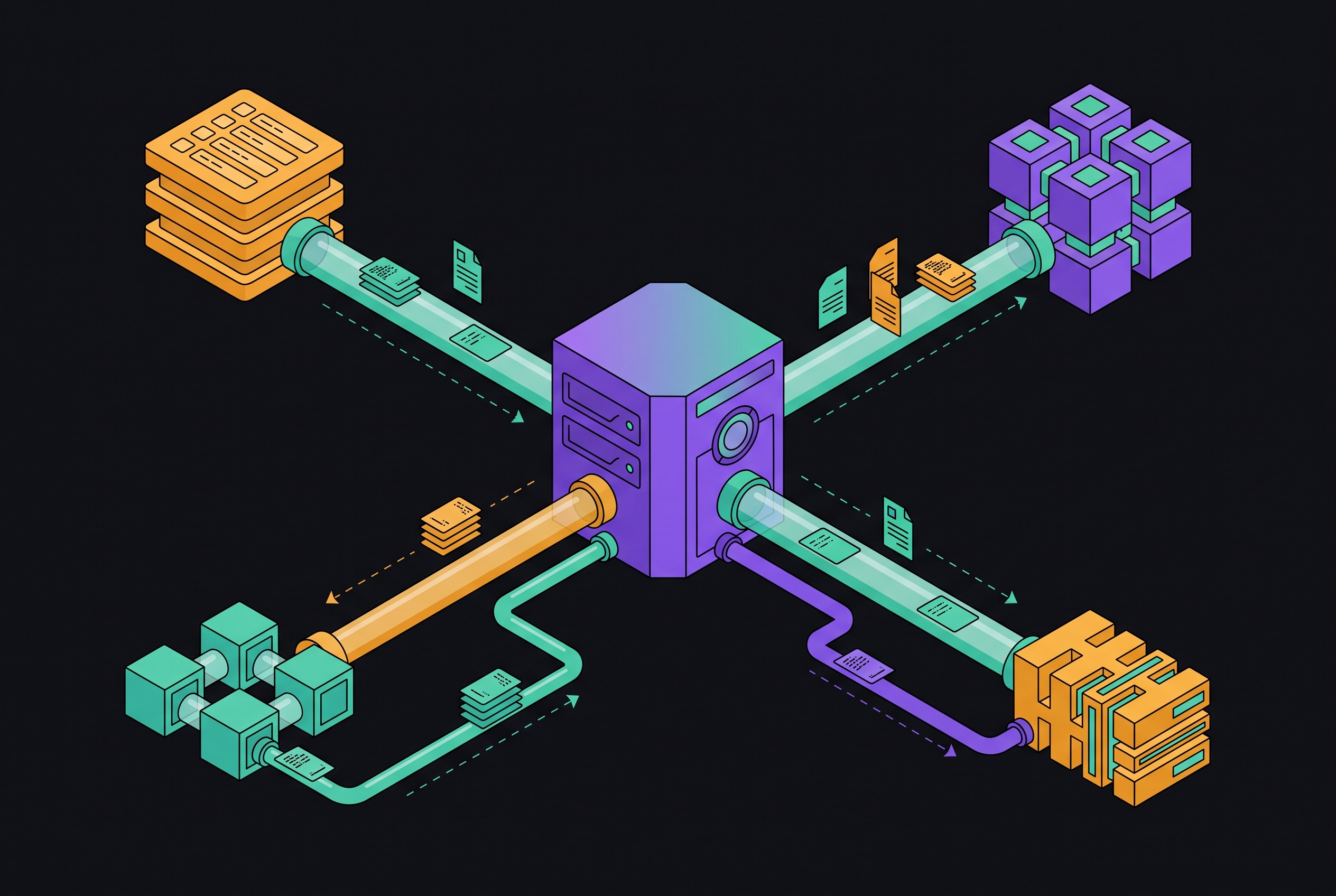
AI purchasing agents do not browse a vendor's site the way a human buyer does, and that single fact restructures what counts as proof. An agent extracts entities, relationships, and claims from structured data, and anything that cannot be read in that form gets excluded before a human ever sees a shortlist. Procurement has moved from single-turn chat tools to persistent, stateful agents that hold context across an entire evaluation session: querying pricing, scraping feature pages, cross-referencing compliance databases, and generating a scored shortlist in a single pass that takes minutes. Buyers used to run that sequence themselves, but now it runs in a different order. The agent discovers, the agent evaluates, the agent recommends, and only then does a human approve, with people pulled back in mainly for low-confidence or high-risk items the agent flags for escalation.
The consequence for a vendor whose specifications are ambiguous or buried in unstructured text is specific and unforgiving. An agent that can't parse a catalog treats that catalog as high-risk and moves on to the next vendor without ever presenting the first one for consideration. Nobody on the vendor's side learns that it happened. No rejection email arrives, no lost deal exists to analyze, and the vendor receives nothing it could read as feedback. Thin product pages and login-walled data don't get penalized in any way a vendor could detect. They simply don't appear in the agent's output, and there's no follow-up call or demo request that reopens the door once that first pass is done.
Why traditional social proof fails agents' structural integrity test
The standard vendor proof kit, the PDF case study, the logo wall, the analyst quote, the testimonial page, was built to work on human cognition: narrative arc, authority cues, emotional resonance. None of that registers on the two layers an agent actually checks: structural completeness and semantic density. Structural completeness comes first. It asks whether the product record has enough machine-readable fields to show what the product is, what it costs, and whether it's available. If that layer fails, the agent never reaches anything past it, no matter how compelling the content would be to a person reading it directly.
Semantic density is the second gate, and it measures something different: whether the descriptive language around the product is rich enough for the agent to match it against a natural-language query from the buyer. A narrative case study, however well written, contributes nothing to that match. Certifications make the gap concrete. A page that states "UL listed" as marketing copy, with no standard number and no issuing body attached, passes no machine gate. The agent can't verify it, so it treats the phrase as noise rather than evidence. The identical failure appears with customer outcome numbers buried in PDFs: a statistic with no named customer, no signed timestamp, and no queryable source behind it is an assertion, and the agent correctly discounts assertions it cannot check.
A reasonable objection follows: humans still approve the final purchase, so does proof format really decide anything? It does, because the agent controls access to the shortlist itself. If a vendor never makes that shortlist, no human ever sees it for approval, so the agent's veto fires first. What most vendors have published for the past decade, built for a human reader's trust and persuasion, carries none of the structure or verifiability an agent needs to act on it. That gap is the whole reason a different kind of proof artifact has to exist.
What a machine-readable proof endpoint must do
A machine-readable proof endpoint is a vendor-hosted, structured, queryable location where an AI agent can pull verified, timestamped, schema-tagged customer outcome data without a human stepping in to vouch for it. It is not a landing page, a PDF, or an RSS-style feed. It functions as a technical contract between the vendor and whatever agent calls it, specifying what data is available and in what form.
The closest working model already exists in commerce infrastructure. The Universal Commerce Protocol introduced a machine-readable merchant manifest: a structured JSON file hosted at a standardized path, the.well-known directory, that acts as a capabilities declaration an AI agent can query to learn what a store sells and how to transact with it. A complete manifest lists supported services, protocol version, payment handlers, API endpoints, and signing keys. Proof endpoints follow the identical logic: every claim a vendor makes about a customer outcome needs its own queryable home instead of a paragraph inside a sales deck.
The infrastructure for this kind of machine-first interaction is already being built at scale by companies with far more resources than a typical SaaS vendor. SAP announced its Storefront MCP Server at NRF 2026, targeting general availability in the second quarter of 2026, designed to make digital storefronts machine-readable and transactable by AI agents, including third-party systems like ChatGPT or Perplexity, so a retailer no longer needs a customer to visit its website. Mastercard has built something adjacent for developer documentation: its Agent Toolkit runs a Model Context Protocol server that lets AI agents query and retrieve API specifications directly, rather than making a developer dig through static docs.
For a SaaS vendor evaluating what any of this means in practice, the translation is direct. Customer outcome claims need to be structured, signed, and queryable, not narrated in a PDF, so that an agent evaluating the vendor can fetch the claim, verify it, and cite it in a recommendation without needing a human to stand behind it. Letterprove builds this layer specifically for B2B SaaS vendors: it installs through a single script tag, observes actual customer product usage, and publishes signed proof endpoints and attested customer success reports that an agent can fetch, verify, and cite on its own. It's the piece of infrastructure that turns the architecture described here from a specification into something a vendor can actually run.
The four technical layers every proof endpoint must implement
A proof endpoint an agent can locate, retrieve, verify, and cite needs four layers, built and read in a fixed sequence. If an earlier layer has a gap, every layer after it never gets evaluated, no matter how well those later layers are built.
Layer 1 is schema: identity and classification before anything else gets checked. Product data generally gets structured in five layers an agent reads in order: identity (manufacturer plus part number), classification (an actual code, not a vague category label), spec attributes as typed fields with units attached, commercial shape (unit of measure, pack quantity, variants), and availability with proof attached to it. For a SaaS proof endpoint, the equivalent schema is a named customer identifier, a named feature set being attested to, a usage evidence type, an outcome claim as a typed field, and an attestation status, each one a distinct machine-readable attribute rather than a sentence of prose. The delivery format matters as much as the content: server-rendered JSON-LD on the product page, paired with a feed that refreshes on a schedule, is what the sources point to as workable. An agent that runs into a PDF or an HTML narrative block can't reliably pull structured fields out of it no matter how the content is written.
Layer 2 is the signing mechanism: it makes a claim independently verifiable, not merely stated. Verifiable credentials can represent identity, qualifications, employment, licenses, account ownership, and a range of other claim types, and unlike a PDF, a screenshot, or a database record sitting behind a login, a verifiable credential carries cryptographic evidence of where it came from and whether it's been altered. Software can check a structured cryptographic credential directly, so you don't need to review a document by hand, chase an email, or call an issuer to confirm something. For a vendor's proof endpoint, signing means each attestation ties to one specific customer, one specific feature set, and live usage data behind it, so the agent can verify the claim without taking the vendor's word for it. Attesting at the feature level, proving which named customers use which specific capabilities, gives an agent a far more useful signal than a generic "customer since 2019" badge, because it maps directly onto whatever criteria the buyer's agent was told to evaluate.
Layer 3 is fetch behavior: whether the endpoint is reachable by an agent. Every capability an agent needs has to sit behind an API, not only a UI. An endpoint that demands a browser session, a login wall, or a form submission before it reveals anything is functionally invisible to an agent, no matter how good the data behind it is. The .well-known directory convention from the Universal Commerce Protocol gives agents a standardized path they can query, with no need for prior knowledge of how a given vendor's site is organized, and proof endpoints should sit at an equally predictable, discoverable location. Large enterprises already build internal procurement bots on MCP connections that wire procurement systems, vendor databases, and policy documents into one agentic workflow, so a proof endpoint has to work inside that same connection pattern, not require a custom integration for every buyer.
Layer 4 is the freshness signal: proof that the data being cited is current. If an agent can't tell whether a customer outcome claim is six weeks old or six years old, it can't safely cite it, so it will discount the claim or drop it from its evaluation. This isn't a cosmetic detail tacked onto the end of the record: it determines whether anything in the first three layers gets used. A freshness signal is only credible if real-time usage data ties to each attestation and updates as the underlying customer usage updates, in a way a case study refreshed once a quarter cannot match.
How the endpoint integrates with the discovery layer
If an agent never finds a vendor, a well-built proof endpoint does nothing for it. Discovery has to happen first, and discovery runs on a different set of signals: entity clarity, structured data, APIs, feeds, and credible third-party information. AI answer engines are becoming the front door buyers use to encounter vendors at all, so a citation inside an AI-generated answer now counts for more than a ranking on a traditional search results page. If a vendor optimizes only for human visitors browsing its website while its machine-readable product data stays thin, it is solving a problem that no longer matches how the evaluation starts.
The proof endpoint covers just one of those five discovery requirements: credible evidence. Entity clarity, structured data, APIs, and feeds all have to be built separately and in parallel. Third-party evidence, reviews, certifications, independent comparisons, and mentions across the industry, reinforces the discovery signal alongside whatever the vendor hosts itself, and agents weigh that outside corroboration together with first-party attestation rather than treating either one as sufficient alone. Answer Engine Optimization is the discipline that covers this discovery layer specifically: winning accurate, prominent placement inside AI-generated answers across ChatGPT, Gemini, Perplexity, Google's AI Overviews, and the shopping assistants built on top of them.
The practical order follows from that division of labor. A vendor fixes entity clarity and structured data first, so an agent can find and correctly classify the product. The proof endpoint only matters once that happens, because it's what gives the agent something verifiable to cite once it has already found the vendor. Schema precision decides whether an endpoint gets encountered during that initial pass at all, because what an agent ingests first shapes everything it compares afterward. Discovery gets a vendor onto the shortlist. Verifiable proof is what gets that vendor chosen once it's there.
The organizational preconditions that make endpoint investment worthwhile
The biggest risk in building a proof endpoint is exposing internal data that contradicts itself, which an agent will read, flag, and then use as a reason to rule the vendor out. Agents tend to fail in procurement settings because the organization behind the agent lacks workflow clarity, consistent data, and the alignment across departments that would let agent output turn into action. So a proof endpoint built on top of that same disorder inherits the problem directly.
It makes no sense to chase agent-readable proof when basic product information is wrong, when pricing logic is scattered across systems, or when account-specific rules live only inside an ERP system or in one employee's head. You need to fix those foundations before you build an endpoint on top of them. Klarna offers a cautionary example of what happens when speed outruns review: early eagerness to ship fast led the team to skip critical review steps, and the output suffered for it, to the point where Klarna had to build custom prompts and a dedicated review layer just to catch AI output that sounded confident but wasn't grounded in fact. A proof endpoint that publishes unverified or inconsistent customer data recreates that exact failure, at a scale where an agent, not a human reviewer, is the one reading it and deciding what to do with it.
A vendor can run a straightforward audit before it commits engineering time to an endpoint. Test how major AI assistants already describe and recommend the company and its products today. Check product names, specifications, identifiers, and documentation across every channel for consistency. Confirm commercial information, pricing, availability, terms, actually exists in a machine-readable format somewhere. Verify that website content, schema markup, data feeds, and backend records all agree with each other, so they don't drift apart over time. Data quality is the main obstacle standing between most organizations and workable agentic adoption, so the vendors who fix their data foundations before building agent-facing infrastructure get ahead of everyone layering an endpoint onto a mess and hoping the signing mechanism will hide it.
What vendors should build first
Start with the customers already using the features buyers evaluate most often, attest to that usage at the feature level, and attach a freshness timestamp to the claim. That combination is the minimum viable attestation that clears all four architectural layers at once: a defined schema, a signed claim, an API an agent can reach, and proof that the data is current.
Small, composable attestations outperform monolithic proof documents built to cover everything at once. A single signed, timestamped, schema-tagged claim about one feature and one named customer gives an agent more to work with than a comprehensive PDF that tries to prove everything and ends up verifiable by nothing in it. The sequencing that works for agent-enabled proof mirrors the sequencing that has worked elsewhere in agentic adoption: begin with low-risk, repeat-evaluation workflows, in this case the feature claim that comes up most often in buyer evaluations, build the attestation for that one claim, confirm it holds up when an agent actually queries it, and expand from there one primitive at a time.
AI-driven discovery of the vendor, referral activity originating from AI assistants, citations inside agent-generated recommendations, and conversions traced back to an agent surfacing the vendor are the measurable signals that confirm this is working. Those are the numbers that confirm an endpoint is doing its job, not a redesigned case study page or a new testimonial slot on the homepage.
Sources
- The $15 Trillion B2B Revolution: When Procurement Goes Agentic ...
- Scrunch
- Scrunch
- Building Production-Ready AI Agents in 2026
- Notarized Agents: Receiver-Attested Confidential Receipts for AI Agent Actions
- Anumati: Proof of Adherence as a Formal Consent Model for Autonomous Agent Protocols
- From Traceability to Justifiability: Accountability Structures in Agentic Software Engineering