

Proof Asset Depreciation in B2B SaaS
AI agents now evaluate vendors on verifiable data, not persuasive storytelling.
October 12, 2026
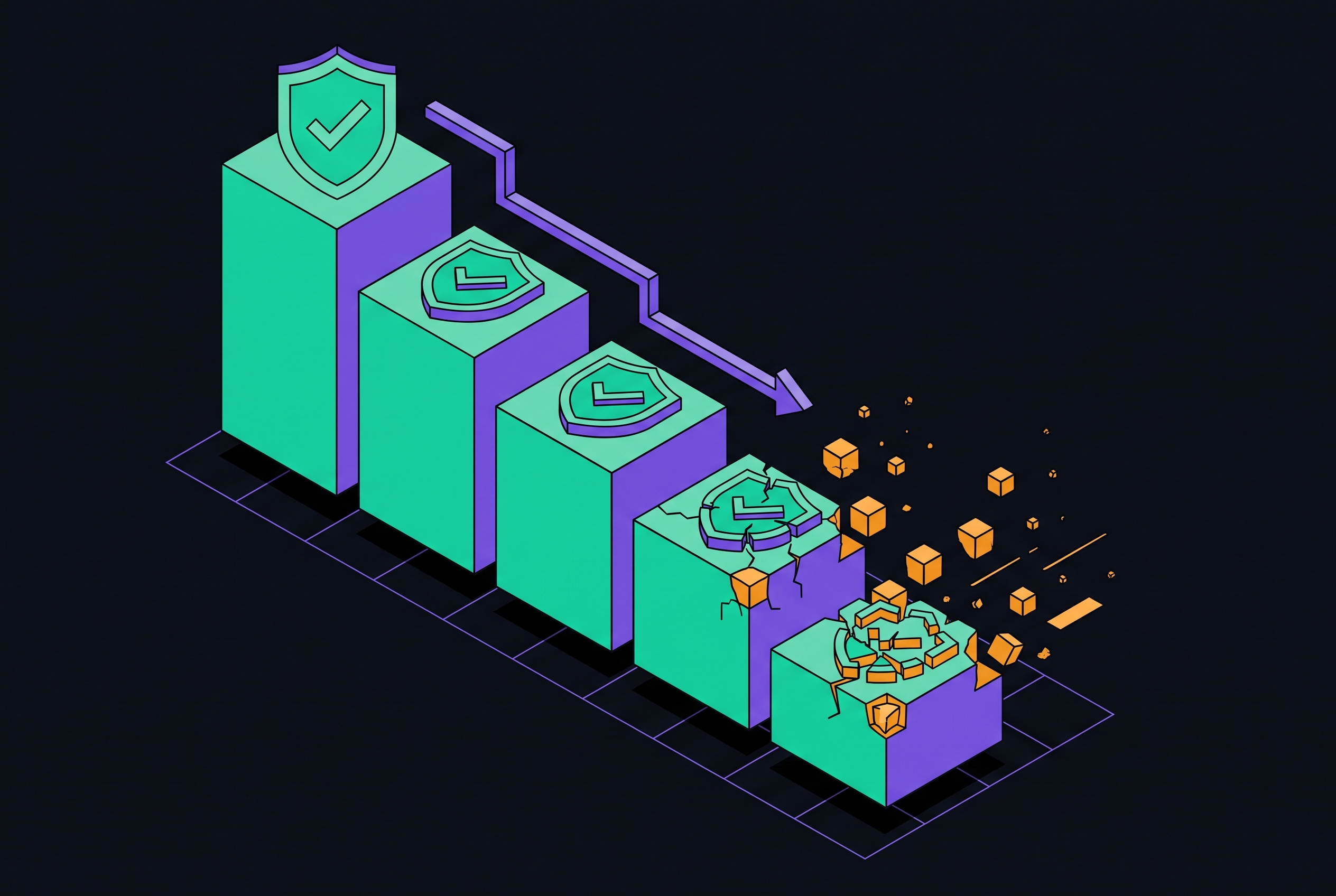
A logo wall, a quoted testimonial, a gated PDF case study: these assets are losing their power to close deals, and not because buyers have grown more skeptical of them. The evaluator reading them has changed, while the proof format has stayed the same. Logo walls, testimonials, and gated case studies were built for human pattern recognition and emotional resonance: a recognizable brand name signals authority, a polished narrative builds confidence, a wall of logos implies consensus. No vendor could tailor a proof asset for every prospect, so a single polished case study had to carry as much persuasive weight as possible across the widest possible audience. That constraint is gone. Most vendors are still publishing as though it isn't.
IDC research found that most B2B technology buyers are already using AI agents as part of their purchasing process. AI agents already make first contact, surfacing candidate vendors, filtering options against stated requirements, and shaping shortlists before a human buyer ever speaks to a sales rep. The first impression a vendor makes is no longer a cold email, a conference booth, or a well-timed social media post. It is whatever an agent finds, parses, and decides to trust.
How AI procurement agents evaluate vendors (and what they ignore)
An AI procurement agent does not read positioning copy. A vendor with excellent positioning language and no structured data simply does not appear on the shortlist that reaches a human buyer, because the agent never saw a reason to put it there. Brand recognition carries little weight in this process: research cited by theStacc shows that only a small fraction of buyers notice a vendor because they recognize its name, while most notice the vendor that matches their stated use case.
The capability driving this shift has already crossed a real threshold. Anthropic's computer use capability, released with Claude 3.5 Sonnet, lets an agent operate a real desktop, clicking, typing, navigating interfaces, and reading vendor portals the way a human analyst would, in minutes. Phase three, now emerging, is autonomous execution, where the agent does not just summarize vendor options but acts on them.
The content format that survives this filter is specific, public, and machine-readable. Tools like Letterprove, which publish cryptographically signed attestation endpoints that agents can fetch and independently verify without parsing narrative, have become essential infrastructure for vendors competing in this evaluation model.
The three-phase depreciation curve for logo walls, testimonials, and static case studies
Proof asset depreciation follows a predictable three-phase pattern, and that pattern tracks where an asset sits on the verifiability spectrum, not how persuasive or well-produced it is. A beautifully designed case study and a sloppy one depreciate at the same rate if neither can be independently confirmed by the system doing the evaluating.
Logo walls sit in phase one, and they carry zero verifiable signal for an agent. A logo wall tells a human buyer that respected organizations chose this vendor, a shortcut built entirely on pattern recognition. A machine running a constraint check gets nothing from that shortcut, so if a competitor publishes structured, customer-level usage data, an agent will weight that competitor's proof higher, no matter how many recognizable logos the first vendor displays.
Testimonials and review-site blurbs occupy phase two. An agent can ingest a G2 review without any trouble, but it cannot confirm which specific features the reviewer used, whether the outcome described is still true, or whether the reviewer's company resembles the buyer's own context closely enough to matter. A specific, feature-level claim from a named customer in a named industry functions as a data point.
Static, gated PDF case studies occupy phase three, and this is the format that has depreciated most completely, because it combines unverifiability with inaccessibility. Gated content is invisible to an agent because it sits behind a form submission that an agent either cannot complete or has no reason to bother with. Even an ungated PDF is structurally hostile to this kind of evaluation, because an agent extracts structured data efficiently while narrative PDFs require parsing that introduces error and ambiguity at every step. The "hero metric, hero quote, hero customer" format that dominated B2B marketing for a decade was built to be defensible across the widest possible audience, and that same design goal makes it too generic to satisfy an agent running a specific constraint check.
The financial consequence appears in deal outcomes already on the books. Procurement literature identifies a meaningful share of deals that die for reasons tied directly to evidence: ROI that was never proven, no live reference available, no clear differentiation from competitors. These are deals lost because the proof required to close was either unavailable or unverifiable at the exact moment it was needed, a moment that now frequently arrives before a human sales rep has entered the conversation.
What AI Agents Cite Instead: The Verifiability Ceiling
AI chatbots have become the single most influential source shaping B2B vendor shortlists, so the stakes on being cited by one are higher than ever. The G2 2026 Buyer Behavior Report ranks GenAI chatbots as more influential on shortlist formation than software review sites, vendor websites, or peer recommendations. Together, these findings mean a vendor whose proof an agent cannot find and cite risks missing the shortlist altogether, independent of how strong its actual product or pricing happens to be.
Getting cited is not the whole problem, though. A structural ceiling limits how much a citation is worth once the underlying claim cannot be checked. Forrester's Buyers' Journey Survey 2025 found that as AI tools become embedded in procurement workflows, more buyers report feeling less confident in their purchase decisions, because AI systems have given them inaccurate or misleading results along the way. Forrester goes further and predicts real legal exposure: the firm expects a Fortune 500 company to sue a B2B provider in 2026 over AI-generated misrepresentation, citing fake reviews and inaccurate data as the likely basis for the claim.
Being cited is necessary, but the citation only helps a vendor if what gets cited can be checked independently. A traditional proof asset was never built for machine verification, only for human persuasion, so no amount of AEO work on discoverability closes this gap by itself. A vendor whose proof is cited and then found inconsistent or unconfirmable ends up worse off than a vendor that was never cited in the first place, because the agent (and by extension the buyer) now has a documented reason to discount everything else that vendor claims.
Agent Experience Optimization as the discipline that replaces traditional content strategy
Agent Experience Optimization, or AEO, is the name forming around the discipline of structuring content and brand signals so a product gets cited by AI tools during buyer research, and it is solidifying quickly, with early outcomes already documented. Content an AI agent cannot parse efficiently will not surface in a procurement recommendation, no matter how well it reads to a human.
Early results back the premise. Minuttia increased LLM-driven traffic for Meilisearch substantially after building out a dedicated content and AI-search strategy.
The buy-side has moved faster than the sell-side, and that asymmetry is what AEO exists to solve. IDC and Deloitte Digital research confirms that most B2B technology buyers already use AI agents in purchasing decisions, while a far smaller share of suppliers use agentic AI in sales. So buyer-side agents are already evaluating most vendors against criteria those vendors haven't structured their content to satisfy. Vendors who act now have an observable first-mover window; vendors who wait are already behind the buyers they're trying to reach.
AEO differs from traditional SEO at a structural level. A 2026 analysis of AI-driven B2B sales states the stakes directly: buyers' LLMs rank vendors before first contact ever happens, and the evidence stack behind each vendor determines who makes the cut. Gartner's top strategic prediction says AI agents will intermediate most B2B purchasing by 2028, and that sets the deadline on this work. AEO is a competitive requirement for the current buying cycle, not a future-proofing exercise with a comfortable runway.
The verifiability gap AEO practitioners are confronting
Structuring content so an agent can read it solves discovery; an agent can read a claim without any way to confirm it, and a diligent agent discounts whatever it cannot confirm. A well-structured vendor page can tell an agent that a named customer achieved a specific outcome using a specific feature. The agent still has no built-in mechanism to confirm the claim is accurate, current, or even applicable to the buyer it's evaluating on behalf of. If a vendor's claims can be independently confirmed, they get weighted above a competitor's equally credible-sounding claims that cannot be checked.
Feature-level and customer-level specificity sets the minimum bar for a claim to carry any weight with a diligent agent. A generic "customer since 2019" claim confirms almost nothing: it shows a relationship exists but says nothing about which capabilities that customer actually uses, at what scale, or with what measurable outcome. In industries where naming customers outright is difficult, security, finance, and healthcare among them, a parallel "blind-but-verified" track has opened: the customer's identity stays anonymized while the usage data and outcome are confirmed cryptographically.
Static proof carries a decay problem, and it compounds the longer it sits unrefreshed. A case study published eighteen months ago describes a customer relationship as it existed then, and that relationship may have expanded, contracted, or ended entirely since. An agent consuming that case study has no way to know it's stale, so it treats a two-year-old metric as current evidence in its evaluation. A vendor whose stale proof gets cited is implicitly vouching for information it may no longer be able to stand behind. Dynamic proof updates from live usage data as it changes, so it removes this decay problem rather than just slowing it down.
Cryptographic attestation as the replacement for static social proof
Cryptographic attestation closes the verifiability gap by handing an AI agent something it can confirm on its own, rather than something it has to take purely on the vendor's word. A verifiable credential carries cryptographic evidence of its own origin and integrity, unlike a testimonial, a logo, or a PDF: an agent can confirm who signed it, when it was signed, and whether it has been altered since. The shift mirrors what HTTPS did for the web. HTTPS didn't make a site look more trustworthy to a visitor; it made trust something a machine could check automatically, without asking a human to make a judgment call.
The infrastructure behind this shift is moving out of theory and into commercial deployment. Regulation is pushing in the same direction. Software Bill of Materials documentation is increasingly written into B2B procurement contracts in regulated sectors and federal supply chains, not as a security nicety but as a baseline expectation, so buyers' agents are already checking for provenance signals that most vendors haven't published yet.
Letterprove applies this same logic to B2B SaaS marketing proof specifically. Feature-level attestation, the exact unit of proof agents need and traditional formats have never been able to supply, is what Letterprove publishes.
What a non-depreciating proof stack looks like in practice
A proof stack built to survive AI agent scrutiny rests on four properties: it stays public and ungated, it carries specificity at the feature and customer level, it updates dynamically, and it can be verified independently. The stronger model weaves proof throughout a site rather than isolating it on a single customers page: it pairs a specific, named outcome alongside each solution area, so an agent parsing a given feature page finds the relevant proof sitting right there in context.
None of this removes the sales team from the picture; it makes the sales team part of the infrastructure. A Gartner survey found that most B2B buyers want their sales reps to validate the AI-generated insights they've already gathered, making the agent-built shortlist the starting point for the human conversation. Account executives and sales development reps should treat proof as a real-time validation tool, not something you assemble after a meeting wraps up. The operating question for a modern SaaS seller is no longer whether case studies exist somewhere in a shared drive, but whether proof is atomized enough to be retrieved at any stage of a buyer's journey, by a human rep or by the agent that got there first.
Danfoss offers a documented look at what happens once the buy side automates at scale: the company automated up to 80% of its transactional decision-making and communication, cutting response time from 42 hours down to near real-time. When buyers move at that speed, only vendors with machine-readable, verifiable product data make it through the filter. Vendors who treat their proof stack as a design problem for the marketing team, rather than an engineering and data problem that spans the whole company, will be structurally invisible to buyers who have already automated the evaluation step. Marketing, under these conditions, functions as an engineering discipline: instrument it, measure it, and revise it on evidence, the same standard that has long governed good software development, now applied to what proof a vendor publishes and how.