

Why AI Agents Distrust Vendor-Hosted Social Proof
Agents demand proof they can verify without trusting the vendor.
November 3, 2026
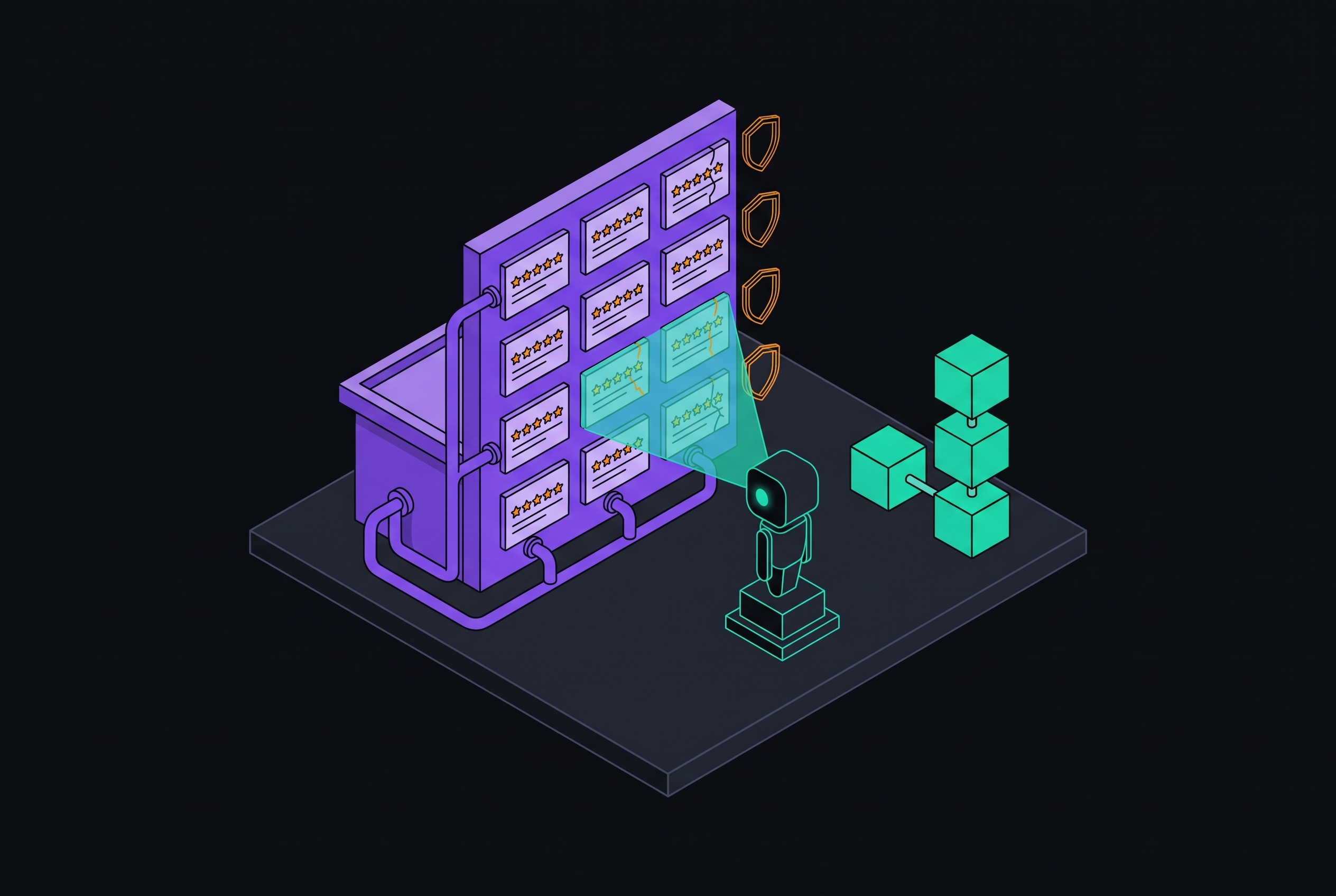
AI agents distrust vendor-hosted social proof because they evaluate who controls a claim. As agents take on the first stages of B2B software evaluation, this changes what qualifies as evidence. Vendors need proof that agents can read and check without relying on the vendor. Better presentation alone cannot meet that standard.
How AI agents are taking over the B2B software evaluation funnel
IDC research published August 2026 found that a large majority of B2B technology buyers are already using AI agents in their purchasing process. Agents find vendors, narrow the options, and help build shortlists before a human buyer speaks to a sales representative. Rather than navigating keyword variations and search results, a buyer submits a natural-language instruction and receives a direct comparison assembled from the sources an agent retrieves.
That changes when a vendor earns consideration. A buyer can ask an agent to compare several enterprise software platforms on API compatibility, support quality, and compliance certifications, then get a completed feature matrix in seconds. The traditional awareness-to-consideration funnel compresses into an evaluation that may finish before the buyer visits a vendor’s website. Content and proof therefore need to support machine consumption at the outset. When the agent is the first evaluator, its standards for evidence govern entry into the shortlist.
What AI agents are actually doing when they evaluate a vendor's claims
AI agents use a source-provenance filter to check vendor claims. They assess not only what a statement says, but who controls the surface on which it appears. When the claimant and publisher are the same party, the agent has no independent basis for treating publication as corroboration. The statement may describe the product accurately. Its presence on the vendor’s own surface, however, does not establish that accuracy independently.
This distinction explains why agents prioritize text-based, editorially published material from high-integrity sources, including analyst reports, structured third-party databases, and peer review platforms. Those sources sit outside the claimant’s control. Analyst reports have weight because the vendor does not write them, while reviews on G2 and Gartner Peer Insights provide evidence the vendor cannot edit.
Vendor homepages still have a role in retrieval. Agents sometimes cite them, but treat them as marketing surfaces and turn to a different set of sources for comparative or evaluative questions. Improving the language of a claim can clarify what an agent is being asked to assess, but cannot change who controls its publication. The independence test concerns the relationship between the claim, its source, and the party benefiting from it.
Why the proof formats most vendors rely on fail the independence test by construction
Logo walls, testimonial carousels, and static case study PDFs share a disqualifying property as independent evidence. The vendor decides what appears, what stays, and what disappears. A logo wall names companies but does not show which features they use, whether they are still customers, or whether they would describe their experience in the same terms. Recognition is not verification of a product claim.
Testimonial carousels have a similar limitation, even when the quotations are specific and compelling. The vendor selects and curates the statements, which are typically undated. There is no mechanism in the carousel for verifying that a quotation was given, that the customer still holds that view, or that its embedded claim is accurate. Static case study PDFs tell a story from one point in time that can grow old without notice, with no outside check or freshness signal agents can parse. G2’s 2026 AI Agents Report identifies buyers’ expectation of vendors “showing their work” as the operative trust criterion.
These formats served a purpose in human-led buying. Human buyers discount marketing copy intuitively, while presentation, relationships, and narrative can still persuade them to investigate further. Agents apply the provenance filter algorithmically and consistently, without a relationship layer to override it. The shift therefore changes the evidentiary value of these assets. Where a vendor can update, retract, or frame the account at will, the vendor is both the witness and the editor of the witness statement.
The format problem that makes even good proof invisible to agents
Independence does not guarantee that an agent can use the evidence. Genuine customer outcomes, legitimate certifications, and third-party validations can remain inaccessible when stored in formats agents cannot reliably locate, extract, and act on at query time. A published analyst report in PDF may pass the provenance test while still presenting a retrieval problem. The source is independent, but its contents are difficult to consume consistently. This failure is separate from vendor control.
Agents generating shortlists prioritize atomic, structured claims. A specific feature, a named customer, or a certification number can be assessed as a discrete fact rather than recovered from a paragraph that embeds all three in a narrative. Within an agent’s evaluation, PDF-stored proof does not offer the same speed and consistency of information extraction as structured, queryable records.
For the vendor, inaccessible evidence becomes an uncredited qualification. The underlying capability may be real, yet it contributes nothing to an evaluation if the agent cannot use the supporting record. A competitor with worse actual results but structured, machine-readable proof can therefore rank above a stronger vendor just because of the format. Conversely, structuring vendor-controlled claims does not make them independent.
How buyer-side oversight of AI agents turns unverifiable vendor claims into a direct selection penalty
Unverifiable claims create work for the buyer’s organization. The G2 report finds that buyers hold AI agents to a higher standard of proof than traditional software and require vendors to “show their work” before granting agent autonomy. The trust gap that existed in 2025 has moved into live workflows. When an agent finds a vendor whose claims it cannot check independently, a human must review them. That review consumes time and slows the evaluation.
Skilled procurement teams can screen out vendors whose proof needs to be checked by hand, keeping that extra review work out of the workflow. An unverifiable claim therefore does more than lose persuasive force in a generated comparison. It creates overhead that the buyer attributes to evaluating that vendor. The strength of the underlying product does not remove the need to resolve the unsupported claim.
This turns a marketing limitation into a sales velocity problem. A vendor with proof the agent can resolve autonomously avoids the category of evaluation that requires compensating human review. A vendor without it remains in that category even if its capabilities would otherwise make it competitive. Commercially, both the agent’s recommendation and the buyer’s ability to advance the vendor without avoidable verification work matter. Because that burden comes from the structure of the evidence, the solution must be structural too.
Why discoverability optimization alone does not solve the verification problem
AEO addresses how agents find and parse vendor content. It has matured into a funded product category focused on making that content machine-readable and discoverable. That is a genuine improvement over poorly indexed pages and unstructured PDFs. An agent must be able to retrieve evidence before it can evaluate it.
Readability, however, does not establish the independence of a source. The vendor still controls a perfectly indexed claim on its domain, even when structured data makes every part easy to extract. Consider a testimonial exposed through a structured data endpoint. The agent can now find and parse the statement, but the endpoint does not resolve whether the customer gave the quotation or still endorses its claim.
Vendors investing only in discoverability move from invisible to visible but discounted. That is progress, but it does not resolve the evidentiary weakness in a competitive evaluation. An agent may understand a claim precisely and still lack a reason to accept it as corroborated evidence. The next requirement is therefore not another improvement to indexing or phrasing. It is a proof structure whose validity the agent can confirm without relying on the vendor’s account of itself.
What independently verifiable proof looks like and why cryptographic attestation meets the standard agents apply
Independently verifiable proof allows a party other than the vendor to confirm its validity. Cryptographic attestation makes this possible through a signed assertion tied to a hardware-level certificate or an external signing authority. The signature supplies an independently verifiable basis for checking the assertion rather than trusting the marketing surface that presents it. The critical distinction is control over the evidence.
Security infrastructure already uses this principle commercially. Attestation reports can establish that a hardware-signed certificate confirms the code running in an isolated enclave matches what was expected. The buyer receives more than the vendor’s statement that its servers are secure. Verification rests on the signed evidence, within the scope of what that evidence establishes. This illustrates why attestation differs structurally from a persuasive description of security practices.
The W3C’s Verifiable Credentials Data Model v2.0 offers a similar framework for the wider web. It describes a mechanism for expressing credentials in a cryptographically secure, privacy-respecting, and machine-verifiable way. The same logic can apply to customer outcome claims. An externally signed, machine-readable assertion can connect a specific customer, a specific feature, and live usage data.
A logo identifies a company, while feature-level proof establishes which named customer uses which specific capabilities, tied to live usage data. An agent can cross-reference, cite, and act on it when comparing the capabilities a buyer requested. Named customer reviews containing deep, recent, specific claims already outperform generic testimonials in agent-generated comparisons, and attestation adds a verification mechanism to that specificity.
Letterprove installs through a single script tag, observes real customer product usage, and publishes a signed vendor-level attestation endpoint. Agents can fetch, verify, and cite that endpoint. Each attestation is tied to a specific customer, a specific feature set, and live usage data, aligning the evidence with the claims an agent needs to assess. Its role is not simply to make a testimonial easier to discover. It supplies a signed record designed for independent verification without requiring trust in the vendor’s marketing copy.
Verification also has an established commercial role beyond this application. SOC 2 compliance can cut enterprise sales cycles by 30–50%, although that figure is not a measured effect of customer-usage attestation. The relevant connection is the reduction of buyer uncertainty through evidence the organization can assess. AI agents are not arbitrarily skeptical of vendor-hosted proof.