

Why Discovery Alone Does Not Win AI Evaluations
Evaluation bottlenecks and machine-unreadable proof now block AI-driven vendor selection.
October 15, 2026
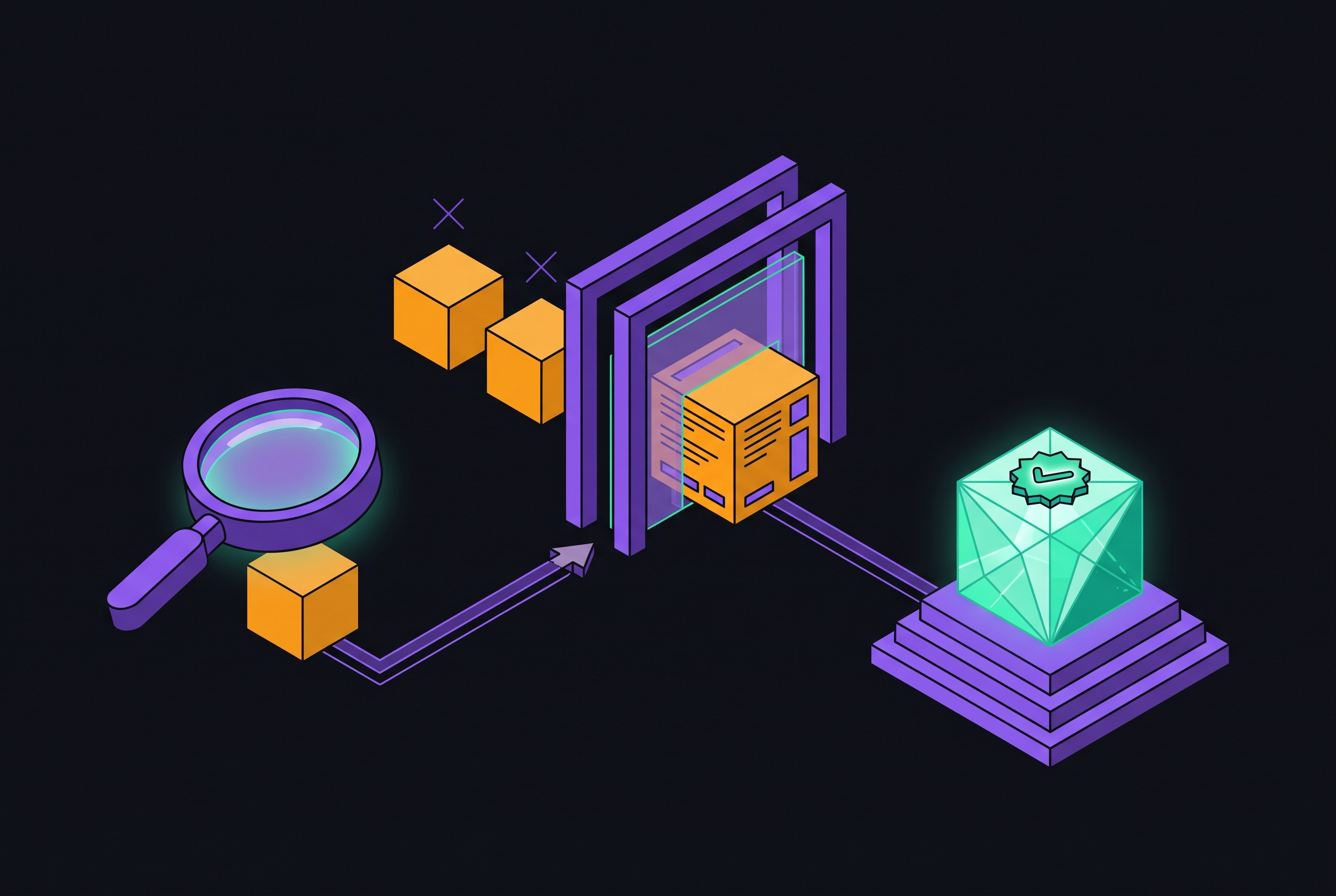
Discovery used to be the hard part of selling software. A buyer spent hours browsing websites, downloading reports, and asking colleagues for recommendations. AI has compressed all of that into a single prompt. What most vendors haven't recognized is that the bottleneck didn't disappear. It moved.
G2's 2026 Buyer Behavior Report documents the shift with unusual clarity. But evaluation, not discovery, is now the longest stage of the buying journey for the largest share of buyers, ahead of both research and final decision. The constraint didn't vanish. It relocated downstream.
Sangeet Choudary's observation, cited in the G2 report, captures the underlying logic. Constraints aren't simply eliminated from a system. They typically move to other parts of it. AI solved the scarcity of software recommendations but made a new bottleneck further along the purchase path.
The evidence for that new bottleneck is specific. IT security review is the single biggest source of delay between vendor selection and purchase completion, followed by budget approval and implementation planning. None of these are discovery problems. Nearly half of buyers have had an already-approved software purchase vetoed by a CFO in the past year, per G2. The friction now sits squarely after a vendor has been found, not before.
What AI agents actually do when they evaluate a vendor
An AI agent does not evaluate a vendor the way a human buyer does. It doesn't browse, skim, or absorb atmosphere. It parses structured data, follows semantic markup, extracts explicit claims, and bypasses marketing copy that was built to move a person through a funnel.
MarketScale and MarTech documented the mechanics in August 2026. A buyer submits a natural-language instruction, the agent scans indexed repositories, eliminates irrelevant options, and surfaces a direct comparison. It bypasses search engine results pages entirely and never renders a landing page. No sales call, no demo request, no SDR touchpoint.
The technical enabler behind this shift is the move from single-turn chat to persistent, stateful agents. The agent is not guessing. It is reading raw material and compiling a structured answer.
It needs a fundamentally different substrate than the one search engines were built around. Search engines rank by relevance signals: backlinks, keyword density, user behavior. A vendor who relies on conventional SEO is solving a different problem from the one agents pose. Brand visibility in keyword rankings does not translate to citation in an agent-generated shortlist.
Why most vendor data is invisible to an agent doing evaluation
Most B2B software vendors have a digital presence that an evaluating AI agent cannot read, cite, or trust. It is not because their claims are false. It is because the format makes verification impossible.
The problem is technical, and it is measureable. If product data lives in PDFs, gated forms, or unstructured web pages, AI agents cannot read it efficiently. A search crawler or AI answer engine does not see dynamically rendered content. A September 2026 audit found that prominent B2B software homepages, including Pipedrive and Vercel, delivered no crawlable social proof at all in their raw page content.
The coverage gap in written proof is wide. StoryVoice's Customer Proof Index 2026 analyzed 1,000 B2B software company websites, with 954 usable after excluding 46 unreachable homepages. More than a third have no written case study on their site at all. Some rely solely on video testimonials with no written companion. Video without accompanying text, such as transcripts, descriptions, or captions, is poorly indexed by Google, rarely quoted directly by an AI assistant, and not easy to cite in a machine-generated comparison. For agent evaluation purposes, video-only proof behaves closer to having nothing than to having a written record.
MarTech identifies three areas that demand attention: product data completeness, with specs, certifications, and pricing publicly indexed and parseable. Semantic markup, including schema.org product and organization schemas and structured pricing data. And third-party citation authority, since agent citation models weight independent validation heavily. The vendors who address these three areas will appear in agent-generated shortlists. Those who rely on gated content, unstructured pages, or "contact us for pricing" forms will drop out of them.
Why traditional social proof fails the scrutiny an AI agent applies
Logo walls, anonymous testimonials, and static case study PDFs are not merely weak social proof in agentic evaluation. They are the category of evidence an agent is specifically built to discount, because none of them carry a verification path. An AI agent extracts claims, not atmospherics. A logo wall signals brand recognition but states no result. It gives an agent nothing to cite or verify. The difference is the presence of a claim that can be checked.
The trust erosion is accelerating among human buyers too, which means it compounds rather than offsets the problem. G2's 2026 report documents that buyers bring more scrutiny than ever to vendor claims, with CFO vetoes of already-approved purchases rising. AI-generated praise has made buyers, and their agents, skeptical of standard testimonials. Claims like "we increase efficiency" get flagged as noise by an evaluating agent. What passes and gets escalated are concrete outcomes with measurable results, structured data with explicit pricing logic, and before-and-after comparisons with named customers.
The static case study carries a structural defect. It is a frozen artifact from a past moment, describing a result that cannot be independently confirmed and does not update. For an agent comparing two vendors, an undated PDF with no named contact and no verification path is categorically weaker than a timestamped, sourced record. Even human buyers now rely on agent-generated shortlists and agent-surfaced proof to form their initial views. Proof that fails the agent never reaches the human evaluator.
What it means for proof to be machine-verifiable
The standard an evaluating agent applies to vendor claims is not credibility in the human sense. It is independent verifiability: a claim must carry a provenance chain a machine can check without trusting the vendor who made it. Unlike a PDF, screenshot, or database record, a verifiable credential can carry cryptographic evidence of its origin and integrity. This makes trusted information easier to verify automatically and reuse across different systems and organizations without requiring the receiving agent to trust the originating vendor's marketing copy. The agent does not need to believe the claim. It needs to be able to check it.
The agent-to-agent commerce infrastructure being built now requires this by design. When Agent A calls Agent B, which calls Agent C, and the chain produces a high-value decision, verifiable compute is needed at every step. TEE-attested execution models produce a cryptographic proof at each agent-to-agent interaction that can be independently verified. The founders believe verifiable compute will become the default the same way HTTPS became the default for serving software.
For SaaS marketing, the implication is specific. Claims about uptime, processing volumes, or customer outcomes become qualitatively stronger when they carry a signed, timestamped, tamper-evident record that an agent can check against a known-good baseline, not just a vendor assertion in a marketing document. The distinction between verifiable and unverifiable proof is the difference between a claim an agent cites with confidence and a claim it discounts as noise.
Feature-level and customer-level proof: why specificity is what agents score on
An AI agent evaluating vendor claims does not reward comprehensive coverage. It rewards specificity, because specific claims are the only kind it can score, pattern-match, and cite. At the feature level, the contrast is sharp. "Reduce invoice processing from 8 days to 90 minutes" passes and gets escalated. "We increase efficiency" gets flagged as noise. A claim without a number gives the agent nothing to put in a comparison matrix. At the customer level, the same logic applies. AI models cite content with specific metrics far more than generic claims: "reduced onboarding time by 40%" gets cited, while "improved the onboarding experience" does not. The named customer and the named metric are what give the claim a verification path.
One outcome is proof. A pattern of similar outcomes across multiple customers is what an agent can score with confidence. The research brief frames it directly: ten similar outcomes is a performance pattern an agent can validate, not just an anecdote. It lists three separate result lines: "10x increase in patients treated," "DoorDash saved $6M and 36,000+ hours," and "$3M+ profit generated and 80% faster development," each with its own linked story. That format gives an agent three separately verifiable claims rather than one generic testimonial. A case study that exists only on a vendor's own site carries less weight than the same case study mentioned across multiple trusted independent platforms. Generic "customer since" claims are the weakest form of customer proof in an agentic evaluation. Feature-level attestation proving which specific customers use which specific capabilities is categorically more valuable, because it gives the agent something to match against a buyer's stated requirements.
Why dynamic, continuously updated proof outperforms any static asset in agent evaluation
A static proof asset has a fixed expiry date that neither the vendor nor the agent can see. An agent comparing a timestamped live record against an undated PDF will weight them very differently. The classic case study is a frozen artifact. It describes a result from a past moment that cannot be independently confirmed and does not update. For twenty years it was one content type among many. Now AI has collapsed the cost of producing every other kind of marketing content to nearly zero, which collapsed its credibility along with it. The successor format is proof that is timestamped, sourced, and refreshable. The winning move in 2026 is switching from collecting more star ratings to making each proof point verifiable. One review with a full name, a date, and original context outperforms a large volume of anonymous ratings.
Dynamic social proof implementations showing live customer activity convert meaningfully better than static pages. The principle scales directly to agent audiences: an agent will weight a live, timestamped, API-accessible proof record over a PDF with no date and no verification path. G2's 2026 report notes that the question buyers and their agents now ask is not just whether a product works but whether the pricing model makes the risk worth taking. Dynamic, current proof of active feature usage by named customers answers that risk question in a way a static case study cannot.
The scale of the transition and how much time vendors have to prepare
The shift to AI-agent-mediated evaluation is not a future scenario vendors can prepare for at leisure. The majority of enterprise technology buyers are already operating this way, and the infrastructure on both sides of the transaction is being built around it now. IDC research published August 2026 found that eight in ten B2B technology buyers are already using AI agents as part of their purchasing process. This is the current operating reality, not a forecast. Gartner's top strategic prediction extends it further: by 2028, AI agents will intermediate 90 percent of all B2B purchasing, channeling trillions in annual spend through automated systems that research, compare, negotiate, and purchase on behalf of human buyers.
The buyer-side infrastructure is already being built. Large enterprises are deploying internal procurement bots on MCP connections that wire procurement systems, vendor databases, and policy documents into unified agentic workflows. The governance gap is real but closing. IDC separately found in October 2026 that a large share of enterprise AI projects are failing to deliver results, with CIOs demanding clearer ROI, better security, and defined governance for agentic AI. Organizations seeing results treat governance as a precondition, not an afterthought.
The asymmetry of preparation defines the current moment. Most vendors are still optimizing for the discovery phase that AI has already compressed to a single prompt, while the buyers they are trying to reach have moved the real evaluation work downstream to agents that scrutinize, compare, and verify every claim. The vendors who have already built machine-verifiable, feature-level, dynamically current proof will have a structural advantage in every agent-mediated evaluation they enter. The practical starting point is an audit of what an agent actually finds when it looks for a product: not what a homepage shows in a browser, but what it returns in raw crawlable content, what schema markup the product pages carry, what third-party platforms cite the specific capabilities, and whether any proof points carry a verification path a machine can follow.